

About the SAP
Discover the history, operations, and activities of the Société d’Anthropologie de Paris
Société d’Anthropologie de Paris
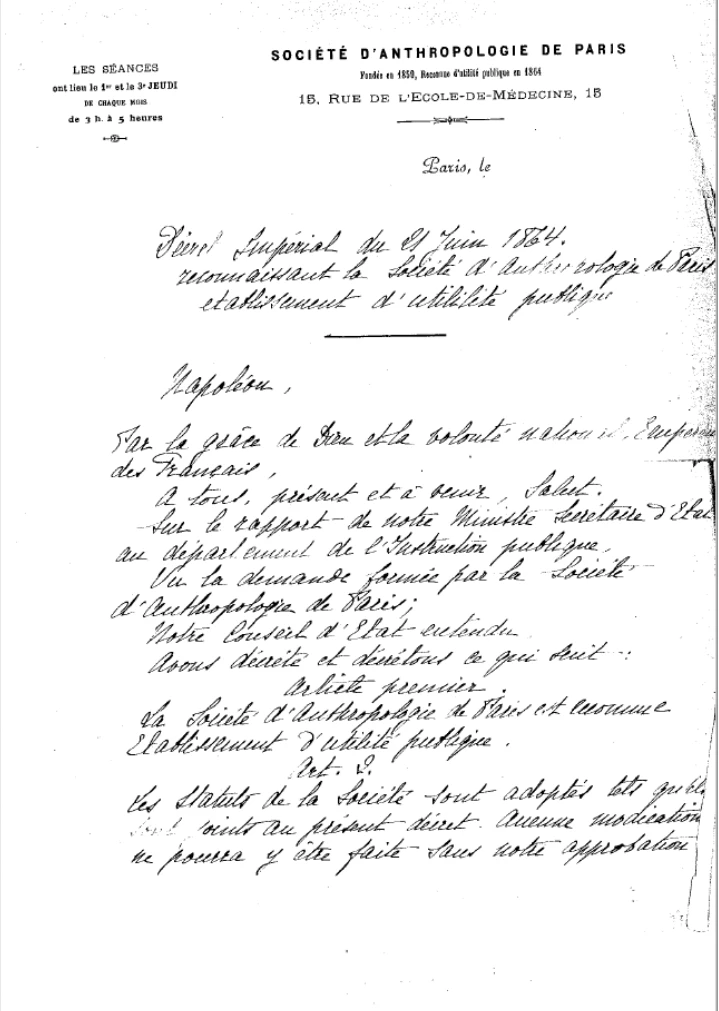
The Société d’Anthropologie de Paris was founded on May 19, 1859, by Paul Broca and 19 other scientific figures. Its influence grew rapidly alongside its membership; it was recognized as a public utility on July 21, 1864. Its headquarters are located at the Musée de l’Homme in Paris.
Its founder, Paul Broca (1824–1880), remained its secretary general until his death. He is one of the fathers of anthropology in its “modern” sense—that is, in his own words, focusing on “the study of the human group as a whole, in its details, and in its relationship with the rest of nature.”
Our anthropology society is the oldest in the world to bear this name, which signifies that the human being is at the heart of its concerns. While it initially brought together disciplines that have since gained their own autonomy (prehistory, ethnography, forensic medicine, demography, sociology, etc.), it now focuses exclusively on biological anthropology while maintaining its central position at the crossroads of other sciences. Its specificity lies in placing the biological dimension of humans at the core of its approach, which is, above all, an interdisciplinary one. Throughout its existence, it has also—and this is proof of its vitality—embraced new approaches (molecular biology, genetics and paleogenetics, 3D imaging, funerary archaeology, auxology, nutrition, etc.).
Key moments in the history of the SAP
Over 160 years at the service of biological anthropology in France
Founded by 19 members, including Paul Broca
The society is recognized as a public utility
Discovery and publication of the famous Cro-Magnon fossils in the BMSAP
Establishment of the SAP headquarters at the Musée de l’Homme
Organization of an annual symposium, “Les Journées de la SAP,” replacing the four annual scientific meetings
Celebration of the SAP’s 150th anniversary during a week-long international symposium (at the Musée de l’Homme, accompanied by an exhibition of original human fossils from across Europe)
Transition of the BMSAP to Diamond Open Access
Objectives and activities of the SAP
To promote and develop the study of the natural history of humans—that is, the origin and biological diversity of our species.
How the SAP operates
Members of the Board of Directors
The SAP is administered by the following Board of Directors
Yann Ardagna
Editorial Board, Awards Commission
Ameline Bardo
Editorial Board, Awards Commission
Camille de Becdelièvre
Editorial Board, Archives Commission
Benoit Bertrand
Editorial Board
Cécile Buquet
Secrétaire générale, Editorial Board, Awards Commission, Archives Commission, Communication Commission
Bérénice Chamel
Rédactrice en chef, Editorial Board, Archives Commission
Quentin Cosnefroy
Editorial Board, Awards Commission, Archives Commission, Communication Commission
Christine Couture
Trésorière, Awards Commission
Jérémy Duveau
Editorial Board, Awards Commission, Communication Commission
Yann Heuzé
Trésorier Adjoint, Editorial Board
Sacha Kacki
Vice-Président, Editorial Board, Awards Commission
Anne Le Maître
Rédactrice en chef, Editorial Board
François Marchal
Editorial Board, Archives Commission, Communication Commission
Nina Marchi
Webmestre, Communication Commission
Laura Maréchal
Secrétaire générale adjointe, Webmestre, Editorial Board, Communication Commission
Aurélien Mounier
Président, Editorial Board, Awards Commission, Archives Commission, Communication Commission
Olivia Munoz
Editorial Board, Awards Commission
Eliza Orellana-González
Editorial Board, Awards Commission
Caroline Partiot
Editorial Board, Awards Commission, Communication Commission
Floriane Rémy
Editorial Board, Awards Commission, Communication Commission
Maïté Rivollat
Editorial Board, Awards Commission, Archives Commission
Yann Ardagna
Ameline Bardo
Camille de Becdelièvre
Benoit Bertrand
Cécile Buquet
Secrétaire générale
Bérénice Chamel
Rédactrice en chef
Quentin Cosnefroy
Jérémy Duveau
Yann Heuzé
Trésorier Adjoint
Sacha Kacki
Vice-Président
Anne Le Maître
Rédactrice en chef
François Marchal
Laura Maréchal
Secrétaire générale adjointe, Webmestre
Aurélien Mounier
Président
Olivia Munoz
Eliza Orellana-González
Caroline Partiot
Floriane Rémy
Maïté Rivollat
Yann Ardagna
Ameline Bardo
Cécile Buquet
Secrétaire générale
Quentin Cosnefroy
Christine Couture
Trésorière
Jérémy Duveau
Sacha Kacki
Vice-Président
Aurélien Mounier
Président
Olivia Munoz
Eliza Orellana-González
Caroline Partiot
Floriane Rémy
Maïté Rivollat
Camille de Becdelièvre
Cécile Buquet
Secrétaire générale
Bérénice Chamel
Rédactrice en chef
Quentin Cosnefroy
François Marchal
Aurélien Mounier
Président
Maïté Rivollat
Cécile Buquet
Secrétaire générale
Quentin Cosnefroy
Jérémy Duveau
François Marchal
Nina Marchi
Webmestre
Laura Maréchal
Secrétaire générale adjointe, Webmestre
Aurélien Mounier
Président
Caroline Partiot
Floriane Rémy
SAP Prizes
The SAP awards prizes recognizing the work of researchers in anthropology
The SAP Prize
The Société d'Anthropologie de Paris prize, which aims to reward doctoral thesis work in biological anthropology, includes an award whose amount is set annually by the SAP Board of Directors.
Best Poster Prize
The honorary best poster prize rewards the best poster presentation delivered during the SAP annual scientific meeting.
How to apply
For the SAP prize, applications must be submitted to the Society's General Secretariat (the call for which is sent via the mailing list, social media, and the SAP website).
The thesis must be written in French or English and have been defended during the calendar year preceding the application deadline.
For the poster prize, any proposal submitted before the deadline is automatically eligible.
SAP Surveys
The SAP regularly conducts surveys among its members and the scientific community
Decennial surveys on the composition of the SAP
Every 10 years, the SAP conducts a survey to provide a snapshot of its membership composition based on various criteria. It also gathers feedback on several points, providing the Board with direct information from members to guide actions that evolve the society in line with their wishes. The diachronic perspective of these surveys also allows for tracking the evolution of SAP membership and, through them, the landscape of biological anthropology and archaeo-anthropology in France.
Survey on the practitioners of biological anthropology
In association with the Gaaf, the SAP conducted a major survey on the practitioners of biological anthropology in France.
Survey on the effects of Covid
The SAP also conducted a survey on the effects of Covid on our scientific community.
The archives
A collection of documents tracing the scientific and institutional life of the Society since its founding in 1859.
Administrative documents
Bylaws, internal regulations, public utility declaration, and minutes of meetings.
Correspondence
The Society’s correspondence with its members and partner institutions.
Collections & scientific activities
Documents relating to the Society’s collections and scientific work.
Iconographic collection
Photo albums from field missions.
Consult the archives
The collection is held on deposit at the Central Library of the Museum (BCM); consultation is on-site and requires prior authorization.
To consult the archives:
- Select the archives to consult in the SAP collection on the Calames website (online catalogue of archives, manuscripts, iconographic documents, works of art and collection objects).
- Request authorization to consult them from the SAP by email at commarchives@sapweb.fr.
- With this authorization, go to the BCM for the consultation.
- The SAP authorizes the reproduction of archives or iconographic documents, under the conditions defined by the BCM.
Central Library of the Muséum national d’Histoire naturelle (BCM)
38, rue Geoffroy Saint-Hilaire
75005 PARIS, France
Tel: +33 1 40 79 36 27
Fax: +33 1 40 79 36 57
Email: bcmweb@mnhn.fr
bibliotheques.mnhn.fr